

A TV box remote control is more than an accessory. For TV box brands, it is part of the product experience and can also carry the brand identity. When buyers work with an OEM or ODM manufacturer, many parts of a remote control can be customized, from the logo and housing to button functions, wireless technology, and packaging.
However, not every feature can be changed in the same way. Some customizations only require artwork or software changes, while others may require new hardware, PCB changes, or tooling.
Key Takeaways
- Logo, color, housing, and packaging are common branding options.
- Button layout and shortcut keys can be customized for different TV box products.
- IR, Bluetooth, and 2.4G wireless are common control methods.
- Voice control and air-mouse functions require suitable hardware and software support.
- Remote control compatibility should be tested with the target TV box before mass production.
- The deeper the customization, the more development work may be required.
1. Logo and Brand Design
The simplest customization is usually branding.
A TV box brand can customize the logo printed on the remote control and may also choose colors, button artwork, labels, and other visual elements. These changes help the remote control match the appearance of the TV box and the rest of the product packaging.
For B2B buyers, branding can be especially useful when the remote is sold as part of a private-label TV box package.
2. Housing Design and Color
The physical housing can also be customized.
Depending on the project, buyers may choose:
- Housing color
- Surface finish
- Shape and size
- Button style
- Logo position
- Material and appearance
There is an important difference between changing the appearance of an existing remote and developing a new housing. A simple color or artwork change may use an existing structure, while a completely new design can require tooling and engineering work.
Therefore, buyers should confirm the expected customization level before discussing production quantities.
3. Button Layout and Functions
Button layout is one of the most useful areas for customization.
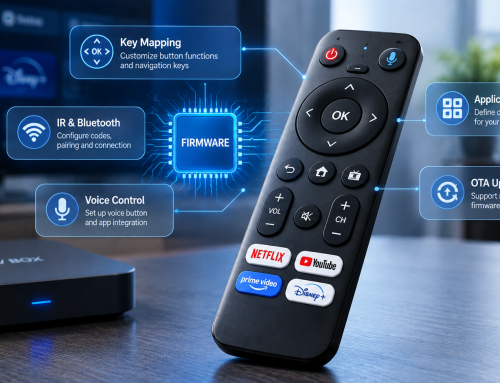
Different TV box products may require different shortcut keys. A brand may want dedicated buttons for Home, Back, volume, applications, search, or other functions.
Android TV uses standard input events for common navigation and media functions. For example, D-pad buttons are used for navigation, while other keys can be mapped to selection or media actions.
This means the physical button layout should be planned together with the software behavior of the TV box.
Typical Customization Options
| Customization Area | Typical Options | Development Level |
|---|---|---|
| Branding | Logo, artwork, color | Basic |
| Housing | Shape, size, material, color | Basic–Advanced |
| Buttons | Number, position, labels | Basic–Advanced |
| Shortcut Keys | App or function shortcuts | Functional |
| Connectivity | IR, Bluetooth, 2.4G | Functional |
| Voice | Voice search and control | Functional |
| Motion | Air mouse and gyroscope | Functional |
| Packaging | Box, manual, labels | Basic |
4. IR, Bluetooth and 2.4G Connectivity
The communication method is another important customization decision.
IR (infrared) is commonly used for simple remote control functions. It can be suitable when the main requirements are basic TV box navigation and power control.
Bluetooth can provide a wireless connection without requiring the remote to point directly at the device. It is commonly used for more advanced TV box remotes, including voice-control models.
2.4G wireless is another option, especially for remotes that include air-mouse or keyboard functions.
BOXPUT already offers different remote control configurations. For example, its BPR2S/BPR2S Plus supports Bluetooth, IR, and 2.4G modes, as well as voice control and a gyroscope.
For buyers comparing solutions, the important question is not simply which technology is available. The remote and TV box need to support the same communication method and required functions.
5. Voice Control and Air Mouse
Voice control can be added to suitable TV box remote designs, but it is not simply a software setting.
A voice remote normally requires suitable microphone hardware, wireless connectivity, firmware support, and compatibility with the target TV platform.
Air-mouse functionality is similar. A gyroscope or motion sensor allows the remote to control a cursor through movement. BOXPUT’s existing W1 Plus remote, for example, includes voice search, gyroscope functionality, air-mouse operation, and IR learning.
For an OEM project, buyers should therefore specify voice and motion requirements before the hardware configuration is finalized.
6. Key Codes and Compatibility
A custom remote control also needs to communicate correctly with the target TV box.
Depending on the design, customization may include key codes, IR learning, pairing behavior, or button mapping.
This is important because changing the physical button does not automatically change what the TV box does. The hardware and software must work together.
For example, Android TV applications receive controller input as key events, and developers assign these events to navigation and media functions.
Before mass production, B2B buyers should test:
- Every major button.
- Bluetooth or 2.4G pairing.
- IR functions where applicable.
- Voice functions.
- Shortcut keys.
- Compatibility with the target TV box firmware.
7. Packaging and Private Labeling
Packaging is another relatively simple area for customization.
A B2B buyer may request:
- Custom retail boxes
- Brand logo
- User manuals
- Product labels
- Barcode or serial-number labels
- Different language versions
- Custom carton markings
This allows the remote control to arrive as part of a complete branded product rather than as a generic accessory.
BOXPUT provides a broader TV device supply chain that includes TV boxes, TV sticks, remote controls, and OEM/ODM solutions for brands and distributors.
8. What Requires Deeper Development?
Not all customization has the same technical difficulty.
Logo printing, artwork, and packaging are relatively simple. Button mapping and connectivity require more functional testing. New housing designs, PCB changes, advanced voice functions, or a completely new remote platform can require deeper engineering work.
This is why buyers should define the project before requesting a quotation.
BOXPUT’s remote control product range provides different existing remote platforms, while its OEM/ODM TV box manufacturing capabilities can support broader product customization requirements.
9. How to Choose the Right Customization Level
The right approach depends on the buyer’s business model.
A distributor may only need a logo, color, and packaging. A TV box brand may require custom shortcut keys and a different button layout. A project buyer may need a new housing, specific wireless technology, voice control, or deeper software integration.
Before production, buyers should provide the manufacturer with the target TV box model, required functions, preferred connectivity, branding requirements, packaging specifications, and expected order quantity.
Google also recommends using descriptive, relevant anchor text for internal links because it helps users and search engines understand the destination page.
FAQ
Can I put my own logo on a TV box remote control?
Yes. Logo printing is one of the most common forms of remote control customization.
Can the button layout be changed?
Yes. Button position, labels, and shortcut functions can be customized depending on the remote platform and hardware design.
Can a TV box remote support both IR and Bluetooth?
Yes, some remote platforms support multiple communication methods. However, the TV box must also support the required functions.
Can voice control be customized?
Voice control can be included in suitable remote designs, but it requires compatible hardware, firmware, and TV platform support.
Does a custom remote require a new mold?
Not always. Existing remote platforms can support some branding and functional changes. A completely new housing design may require new tooling.
What should buyers test before mass production?
Buyers should test button functions, pairing, IR performance, voice control, shortcut keys, and compatibility with the final TV box firmware.
Conclusion
A custom TV box remote control can be customized at several levels. Branding, colors, housing, buttons, connectivity, voice control, motion functions, key mapping, and packaging can all be part of an OEM or ODM project.
The most important point is that customization should be planned around the complete TV box system. The remote control, hardware, firmware, and user interface need to work together.
For B2B buyers, defining the required functions before production can reduce development problems and help ensure that the final remote control matches the TV box, brand, and target market.
Leave A Comment