

How Brands Customize TV Box Remote Controls
Key Takeaways
- TV box remote customization goes beyond adding a brand logo.
- Brands can customize appearance, buttons, connectivity, functions, and packaging.
- Remote design should match the TV box hardware and software.
- OEM and ODM approaches provide different levels of customization.
- The right customization level depends on the target market, required functions, order volume, and project requirements.
Why Brands Customize TV Box Remote Controls
For TV box brands, the remote control is more than an accessory. It is one of the main interfaces between the user and the device. A well-designed remote can make navigation easier, reinforce brand identity, and provide functions that match a specific TV box.
Android TV devices rely heavily on remote controls for navigation. Google’s Android TV documentation identifies the D-pad, select, Home, and Back buttons as core controls, while microphone buttons can support voice input. This means remote design should be considered together with the TV interface rather than treated as a separate hardware component.
For brands developing private-label or customized TV boxes, customization can also create product differentiation. Instead of using the same generic remote as competing products, a brand can develop a remote that matches its product positioning and software experience.
What Can Brands Customize on a TV Box Remote?
Logo, Colors, and Exterior Design
The simplest customization level is visual branding.
Brands can customize elements such as:
- Logo placement
- Housing color
- Surface finish
- Button colors
- Printed labels
- Brand-specific icons
These changes can make an existing remote platform look like part of a complete product family.
For larger projects, brands may also request changes to the housing design, button arrangement, materials, or overall appearance. The exact options depend on the remote platform and production requirements.
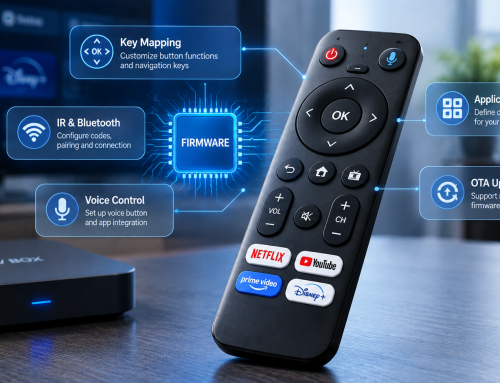
Button Layout and Key Functions
Button configuration is another important customization area.
A standard remote may include directional controls, Home, Back, volume, power, and playback buttons. A customized remote can add or reposition buttons according to the intended application.
For example, a TV box brand may require:
- Dedicated application shortcut buttons
- Custom menu or navigation buttons
- Playback controls
- Volume and power controls
- Special function keys
- Customized button labels
Google recommends predictable TV navigation because users typically operate TV interfaces through limited directional controls. Therefore, adding more buttons does not automatically create a better remote. Button placement should correspond to actual user tasks.
IR, Bluetooth, and Wireless Connectivity
The communication method is another important decision.
IR remotes can be useful for conventional TV and set-top-box control. Bluetooth remotes can provide wireless communication with compatible TV boxes, while some designs combine Bluetooth, 2.4G wireless, and IR functions.
For example, BOXPUT’s BPIR Universal Remote Control uses IR learning and can learn commands from other remotes. This type of design can be useful when a project requires compatibility with existing TV or set-top-box functions.
Bluetooth-based designs can also support more advanced interaction. The Bluetooth SIG defines profiles for Human Interface Devices and audio/video remote-control applications, providing standardized frameworks for compatible Bluetooth devices.
Voice Control and Smart Features
Voice control is increasingly relevant for Android TV and TV box products.
A customized remote may include a microphone and a dedicated voice button. Depending on the platform, it can also incorporate functions such as air-mouse control, gyroscope input, or other smart interaction features.
BOXPUT’s BPR2S/BPR2S Plus Air Mouse Remote Control demonstrates how a TV box remote can combine Bluetooth, IR, voice control, and gyroscope functionality in one design.
These features should be selected according to the TV box software and target market. Adding functions that are not supported by the device can increase complexity without improving the user experience.
Packaging and Accessories
Brand customization can also extend beyond the remote itself.
A complete project may include:
- Branded retail packaging
- User manuals
- Product labels
- Model numbers
- Customized accessories
- Instruction cards
This allows the remote to become part of a consistent product presentation rather than appearing as a generic accessory.
OEM vs. ODM Remote Control Customization
OEM and ODM projects offer different approaches to customization.
| Customization Area | OEM Approach | ODM Approach |
|---|---|---|
| Existing remote platform | Common | Possible |
| Logo and branding | Yes | Yes |
| Button customization | Selected options | More flexible |
| Housing design | Limited to platform | Limited to platform |
| Hardware changes | Limited | More extensive |
| Software/function customization | Project-dependent | Project-dependent |
| Development involvement | Lower | Higher |
| Suitable for | Faster branded products | More differentiated products |
An OEM project can be suitable when a brand already has a clear remote platform and mainly needs branding or selected modifications. ODM is more appropriate when the project requires deeper hardware, function, or design development.
How the Remote Should Work With the TV Box
Remote customization should not be handled independently from the TV box.
The remote needs to work with the device’s hardware, operating system, firmware, and user interface. Button mapping is particularly important because every key should produce the expected result.
For example, a customized Android TV remote may need to support D-pad navigation, selection, Home, Back, volume, power, media controls, or voice input. Android’s official documentation recommends testing TV applications with physical D-pad controllers to identify navigation problems.
BOXPUT’s Remote Control Solution covers multiple remote-control product types and provides a starting point for projects requiring different control methods and functions.
A Typical TV Box Remote Customization Process
A typical project can follow these steps:
- Define the target market and TV box.
- Select a suitable remote platform.
- Determine branding requirements.
- Define button layout and key functions.
- Confirm IR, Bluetooth, 2.4G, or other connectivity requirements.
- Review samples and prototypes.
- Test compatibility with the TV box and software.
- Confirm production specifications.
- Finalize packaging and documentation.
- Move to mass production.
Testing should take place before mass production. A remote that looks correct but has incorrect button mapping, pairing behavior, or software compatibility can create problems after deployment.
What Brands Should Consider Before Customizing
Before starting a project, brands should define several factors:
| Factor | Why It Matters |
|---|---|
| Target market | Determines required functions and design |
| TV box platform | Determines compatibility |
| Connectivity | Determines wireless communication method |
| Button functions | Defines the user experience |
| Customization depth | Affects development requirements |
| Order volume | Influences production planning |
| Packaging | Supports brand consistency |
| Testing | Reduces compatibility problems |
The most suitable customization level depends on the actual project. A distributor may only need a branded version of an existing remote, while a private-label TV box brand may require a customized housing, button layout, wireless solution, firmware configuration, and packaging.
FAQ
Can a TV box remote control be customized with a brand logo?
Yes. Logo printing and other visual branding can be included depending on the selected remote platform and production requirements.
Can brands customize the buttons on a TV box remote?
Yes. Button layouts, labels, and dedicated functions can be customized depending on the hardware platform.
Can a TV box remote support both Bluetooth and IR?
Some remote platforms support combined Bluetooth and IR functionality. The exact configuration depends on the remote hardware and TV box requirements.
Can brands customize voice control?
Voice functionality can be incorporated into compatible remote designs. The microphone, software, chipset, and TV box platform need to support the required voice functions.
What is the difference between OEM and ODM remote controls?
OEM projects generally start from an existing product platform with selected customization, while ODM projects can involve deeper hardware, design, and function development.
How long does TV box remote customization take?
The timeline depends on the customization level, sampling requirements, testing, tooling, and production volume. A simple branding project normally requires less development than a new remote design.
Leave A Comment